“Don’t be tricked by what you see
You got two ways to go”
[What a strange video, and a strange band. But that was the ‘80s!]
There’s a moment in Devo’s Freedom of Choice video where the band stands in a stark, white void—no scenery, no distractions—just a series of absurd “choices” laid out like a game show.
It’s satire, sure, but it’s also prophecy. Devo saw something coming: a society that confuses having options with being free.
Forty‑plus years later, we’re living inside that punchline.
🧭 The Modern Trade: Freedom for Comfort
We talk about freedom constantly—political freedom, economic freedom, personal freedom.
But the real currency of today’s world is comfort. Not luxury. Not wealth. Comfort. The soft, frictionless path. The influencer’s algorithmically curated life. The “don’t make me think too much” lifestyle.
Comfort is the new gravity. It pulls us toward:
- Passive consumption — endless scrolling, autoplay everything, decisions outsourced to recommendation engines.
- Predictable routines — same stores, same brands, same habits, because novelty requires effort.
- Risk‑avoidance — staying in the familiar even when it’s stagnant.
- Convenience dependence — trading autonomy for ease, one tap at a time.
Freedom demands friction. Comfort eliminates it. And when friction disappears, so does the muscle that lets us choose deliberately.
🏢 The Corporate Illusion of Choice
Here’s where the story gets even more Devo‑esque.
We live in a world where shelves look full, brands look diverse, and choices look infinite. But behind the curtain, a tiny handful of corporations own most of what we buy.
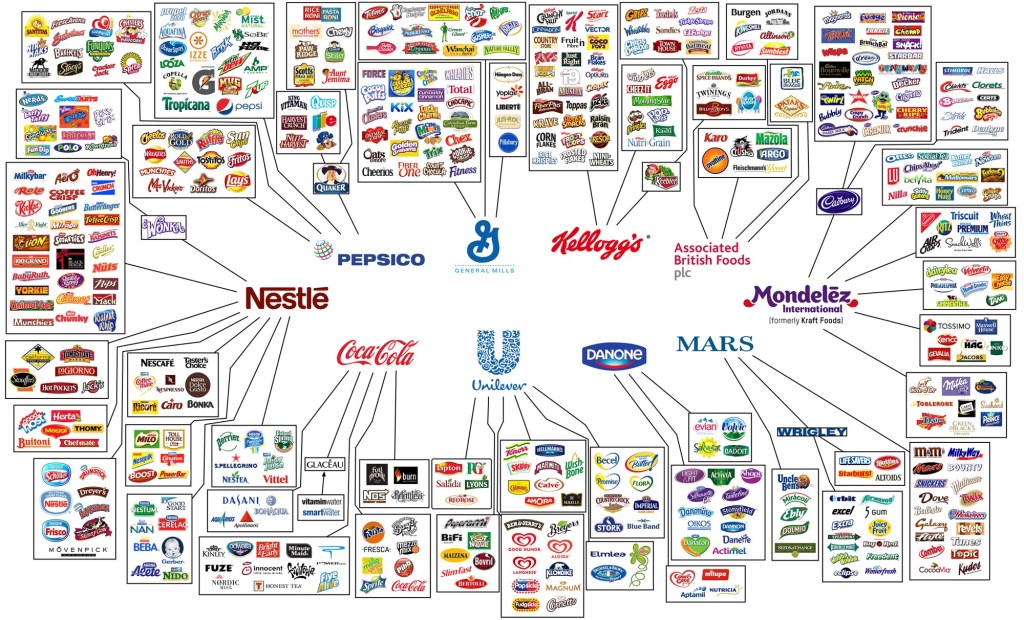
According to sources, roughly 10–15 mega‑companies control thousands of brands across food, household goods, beverages, personal care, and retail.
PepsiCo, Nestlé, Unilever, General Mills, Procter & Gamble, Kellogg’s, Mars, Coca‑Cola — the usual suspects.
Different logos. Same parent.
Different packaging. Same supply chain.
Different “choices.” Same boardroom.
PepsiCo owns everything from Gatorade to Quaker Oats – brands that look unrelated but aren’t.
This is the part Devo predicted without knowing the details:
We’re given the appearance of choice so we don’t notice the absence of freedom.
Corporate consolidation doesn’t just limit options — it shapes culture. It defines taste. It sets norms. It decides what “comfort” looks like and then sells it back to us in 20 slightly different flavors.
🔧 The Illusion of Infinite Choice
We live in a world with 200 streaming services, 40 flavors of seltzer, and 10,000 “personalized” ads per day. But most of these choices are pre‑selected pathways, not genuine freedom.
They’re curated lanes designed to keep us comfortable, predictable, and profitable.
Here is a list of the largest companies by revenue. Some very familiar, some not as much: https://en.wikipedia.org/wiki/List_of_largest_companies_by_revenue?wprov=sfti1#List
Devo’s message hits harder now than it did in 1980:
“Freedom of choice is what you got. Freedom from choice is what you want.”
The band wasn’t mocking stupidity—they were diagnosing a cultural drift. When choices overwhelm, people retreat into the simplest option. And the simplest option is usually the one someone else designed.
🔥 Freedom Requires Discomfort
Real freedom isn’t the ability to pick between 12 nearly identical products. It’s the willingness to:
- Question defaults
- Break routines
- Tolerate uncertainty
- Choose the harder path
Freedom is uncomfortable because it forces us to confront ourselves—our values, our fears, our inertia. Comfort lets us avoid all that.
Modern society rewards comfort with dopamine and punishes freedom with effort.
But effort is where identity lives.
🛠 The Personal Angle
Gen‑X knows this game better than anyone. We grew up making our own choices because no one was making them for us — no algorithms, no guardrails, no “recommended for you” lanes.
That’s why this moment hits differently: we can feel when convenience starts turning into control.
We can tell when a choice isn’t really a choice, just the easiest option in a system built to keep us comfortable and predictable.
Gen‑X is wired to push back against that. We learned early that freedom isn’t what you’re offered — it’s what you insist on.
So the question becomes: Are we actually choosing our lives, or just accepting the defaults?
🌱 A Challenge for the Month
This month’s theme—Freedom of Choice—isn’t about nostalgia. It’s about reclaiming the muscle of intentional living.
Try something different:
Pick a part of your life where comfort has quietly become the default. Then make a deliberate, uncomfortable choice. Something small. Something real.
Freedom isn’t a grand gesture. It’s a habit.
🔚 Free will is a choice
At some point, comfort stops feeling like convenience and starts feeling like surrender. That’s when the old Gen‑X instinct kicks in — the one that remembers what it was like to make choices without algorithms, nudges, or curated menus.
Rush said it better than anyone: “If you choose not to decide, you still have made a choice.”
That’s the whole game right there. Freedom isn’t the number of options in front of you; it’s the willingness to own the one you pick.
So this month, skip the default, break the routine, and choose something that is genuinely yours.
“I will choose a path that’s clear — I will choose free will.”
Until Next Entry: Time Bandits


Leave a Reply