“I’m not a robot without emotions. I’m not what you see
I’ve come to help you with your problems, so we can be free”
🟥 1983 — Before Irrelevance
In the fall of 1983, I walked onto the campus of the University of Missouri–Rolla (now Missouri S&T) with a plan that lasted about twelve minutes.
I thought I was going to be an aerospace engineer. The Registration Fair thought otherwise.
“Not many jobs in aerospace right now,” they said — the first time an institution tried to declare me irrelevant. It wouldn’t be the last. But back then, irrelevance wasn’t algorithmic. It was just bad timing and pessimistic adults.
So they asked what else I was interested in.
I told them the truth:
“My brother and I tear down old computers my dad gives us and reengineer them to do stuff.”
That was enough. They pointed me toward Computer Science — a field so new they didn’t quite know what to do with us. They lumped us in with the electrical engineers and mechanical engineers and hoped for the best.
Freshman year was Physics, Calculus, and Fortran 77.
Our first program was done on punch cards, not because we needed to, but because they wanted us to understand the lineage. We were the first class with access to the IBM 360 terminals and a PC lab — machines with no hard drives, everything running off 5.25-inch floppies that bent if you looked at them wrong.
It was a world where you learned systems by touching them, breaking them, fixing them.
Where nothing pretended to be smarter than it was.
And in the middle of all that, I joined Pi Kappa Alpha, being the only computer science guy in the fraternity house. While everyone else was studying structures or thermodynamics, I was debugging Fortran code at 2 a.m. in a lab that smelled like ozone and warm plastic.
By my Senior year we had the house direct wired to a computer with a 40 MB hard drive to the campus so we could run jobs 24-7. Earned a lot of beers debugging Job Control Language (JCL), Pascal and Fortran programs for my Brothers that year.
I learned Expert Systems, Lisp, Prolog, Robotics and also a side course in Physiological Psychology. Determined way back then we had no idea how humans think and how the brain actually functions.
🟨 2003 — The World Goes Online, But Not Yet Aware
Twenty years after that first semester at Missouri S&T, I found myself in a world that finally looked like the future we were promised in the 80s.
By 2003:
- The internet was no longer a curiosity
- Email was mandatory
- Google had replaced the library
- Cell phones were everywhere
- And “IT” had become a department instead of a hobby
By 2003, I was deep into real engineering—systems, networks, security. The work that actually mattered. Real stakes, real consequences. This wasn’t the punch‑card lab anymore.
🟩 2023 — The Year the Machines Started Talking Back
In 2003, the digital world still felt like an extension of the physical one. By 2023, the digital world had become the primary one — and the physical world was the extension.
The COVID-19 pandemic was the accelerator. That shift didn’t happen totally overnight. It happened in layers, quietly, almost politely, the way erosion works. You don’t notice the cliff disappearing until you’re standing at the edge.
Or until your toaster wants to negotiate a firmware update.
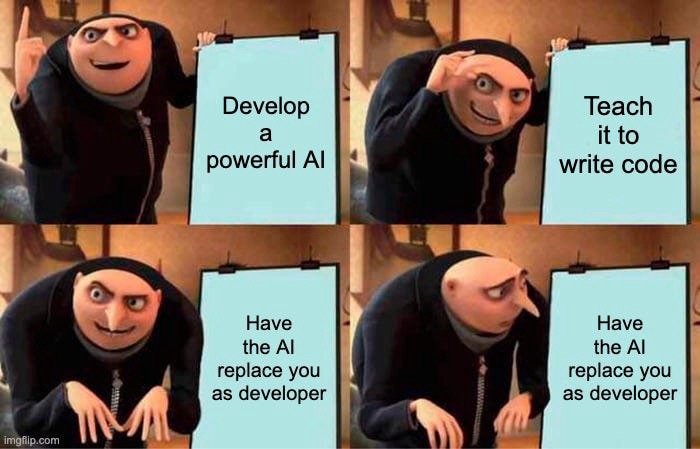
Artificial Irrelevance isn’t about AI replacing people — it’s about people believing they’ve been replaced.
The Gen X read on 2027 and beyond
This era feels like the early 2000s all over again — the moment when the internet stopped being a toy and became the plumbing. AI is entering its plumbing phase. Quiet. Ubiquitous. Unavoidable.
HTML giving way to Prompt Engineering.
And the people who thrive are the ones who can:
- see the system
- understand the system
- integrate the system
- and stay calm when everyone else is sweating the future
Be the “Ghost in the Machine”.
“I work all day at the factory
I’m building a machine that’s not for me
There must be a reason that I can’t see
You’ve got to re-humanize yourself”
And as we head into 2027, the machines will keep taking on more of the surface area of daily life. That’s fine. We’ve lived through bigger shifts.
We survived dial‑up. We survived Clippy. We’ll survive this.


Leave a Reply